Help us improve
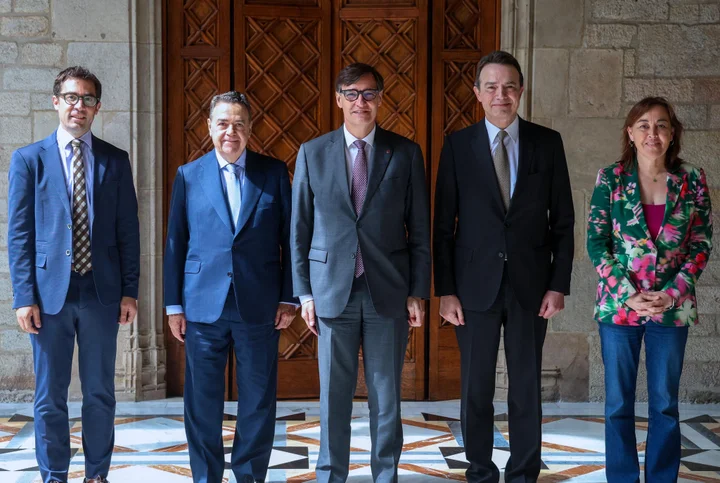
Enagás today launched the Conceptual Public Participation Plan (PCPP) for the Spanish Hydrogen Backbone Network in the Region of Murcia, at a meeting attended by the President of the Region of Murcia, Fernando López Miras; the Regional Minister for the Environment, Industry, Universities, Research and Mar Menor, Juan María Vázquez Rojas; Enagás’ CEO, Arturo Gonzalo; and the General Manager for Energy Transition at Enagás, Natalia Latorre; at the Palacio de San Esteban.
During the meeting, the key features of this infrastructure were presented. The project will be a key driver of the Autonomous Community’s economic, energy, and sustainable development and will also position the Region of Murcia as a key hub within the Mediterranean Arc’s green hydrogen corridor. Furthermore, it will establish the Escombreras Valley (Cartagena) as a potential aggregation hub, where future hydrogen production and consumption projects are concentrated.
Arturo Gonzalo, Enagás’ CEO, stated that “this public participation process in the Region of Murcia represents a further step in the development of a key piece of infrastructure for the energy transition in Spain”. “Our aim is to build this network in collaboration with the local community, incorporating input from public authorities, businesses, and the public, in order to maximise its economic, social, and environmental value and promote new industrial opportunities linked to renewable hydrogen. This will encourage the implementation of projects that generate economic activity and high-quality jobs”.
The Region of Murcia will be served by 44 kilometres of hydrogen pipelines
The Backbone Network will run through the Region of Murcia via 44 kilometres of hydrogen pipelines, forming part of one of the four sections of the ‘Levante Axis’ - namely the Montesa-Cartagena section - passing through a total of six municipalities along its route: Cartagena, Murcia, San Javier, Torre-Pacheco, La Unión and Los Alcázares.
Most of this backbone network will run parallel to the natural gas network, optimising its territorial and environmental integration. It will be instrumental in promoting the development of the territories and showcasing the hydrogen economy.
The Conceptual Public Participation Plan in Murcia will run until 3 July. It includes two in-person participatory events in Cartagena and Murcia, as well as six information points in Cartagena, Murcia, La Unión, San Javier, Torre-Pacheco and Los Alcázares.
This rollout marks the conclusion of Enagás’ Public Participation Plan for the Spanish Hydrogen Backbone Network, which began in April 2025. The plan has enabled the project to be presented in 13 autonomous communities and has engaged a wide range of stakeholders.
An open and transparent participatory process
The Region of Murcia thereby becomes part of the largest public participation plan of its kind in Spain, covering 13 autonomous communities and more than 500 municipalities in 18 months. The PCPP for the Spanish Hydrogen Backbone Network gathers contributions from public authorities, organisations, associations and all citizens who wish to participate.
The Plan’s goal is to provide transparent information on the infrastructure, encourage the active participation of the territories, address concerns, and ensure that the development of the network incorporates the best social and environmental solutions from an early stage.
The project for the first axes of the Spanish Hydrogen Backbone Network involves developing around 2,600 kilometres of hydrogen infrastructure. The hydrogen economy is expected to generate over 32 billion euros of GDP in Spain and contribute to the maintenance of around 81,000 jobs during the development of the Backbone Network.
All available PCPP information can be found at https://www.infraestructurasdehidrogeno.es/en.
/
Help us improve