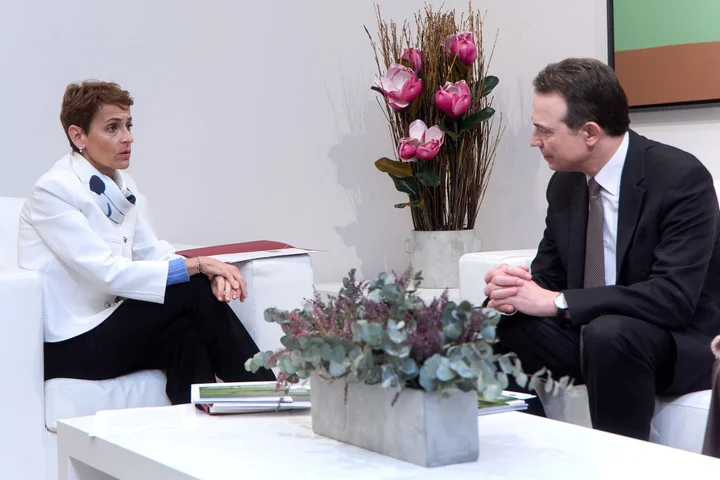
Enagás today presented the Public Participation Concept Plan (PCPP) for the Spanish Hydrogen Backbone Network in the Valencia Autonomous Community, at a meeting held at the Palau de la Generalitat Valenciana, attended by President Juan Francisco Pérez Llorca; the Third Vice-President and Regional Minister for the Environment, Infrastructure, Territory and Recovery, Vicente Martín; Enagás CEO Arturo Gonzalo; and the company's Director General for Communication, Institutional and Investor Relations, Felisa Martín. During the meeting, the main characteristics of this strategic infrastructure were detailed, which will have an extensive route in this Autonomous Community and which will be key to boosting its energy, economic and sustainable development.
Mr Pérez Llorca stressed the importance for citizens of "having detailed and transparent information on this strategic initiative that will pass through our territory and that will serve to listen, dialogue and reach a consensus on solutions", and highlighted the commitment of the Valencia Regional Government (the Generalitat) to "green hydrogen as a key element in the energy transition" and the support of the Generalitat to "socially and environmentally guarantee the development, storage and supply of this energy".
Enagás CEO Arturo Gonzalo said that "this Conceptual Public Participation Plan for the Spanish Hydrogen Backbone Network in the Valencia Autonomous Community will allow town and city councils, local and national governments, agencies and citizens to play a leading role in its development in such a strategic region for the green hydrogen value chain".
The Hydrogen Backbone Network will pass through 100 municipalities in Castellón, Valencia and Alicante
The route of the Trunk Network will pass through 100 municipalities in the three provinces, forming a large part of the 'Levante Axis', which will connect Catalonia, specifically the province of Tarragona, the Valencian Community and the Region of Murcia.
The 'Levante Axis' will be made up of four sections, which in its route through the Valencia region will include 31 km of the Tivissa-Salzadella section between Tarragona and Castellón; 127 km of the Salzadella-Paterna section between Castellón and Valencia; 73 km of the Paterna-Montesa section, entirely in the province of Valencia; and 162 km of the Montesa-Cartagena section, between Valencia and the Region of Murcia.
In the province of Castellón, the Network will pass through 23 municipalities: Almassora, Almenara, Alquerías del Niño Perdido / les Alqueries, Benlloc, Borriol, Borriana/Burriana, Cabanes, Canet lo Roig, Castelló de la Plana, Chilches/Xilxes, la Jana, la Llosa, la Pobla Tornesa, la Salzadella, la Torre d'en Doménec, les Coves de Vinromà, Moncofa, Nules, Sant Mateu, San Rafael del Río, Traiguera, Vilanova d'Alcolea and Vila-real.
In Valencia, the route will pass through 54 municipalities: Aielo de Malferit, Agullent, Albaida, Alberic, Aldaia, Alfarb, l'Alcúdia, l'Alcúdia de Crespins, Alzira, Antella, Benavites, Benimodo, Bétera, Bocairent, Càrcer, Canals, Carlet, Catadau, Cerdà, Chiva, Cotes, el Puig de Santa Maria, Gavarda, Godella, Guadassuar, la Granja de la Costera, Llombai, Llanera de Ranes, Loriguilla, Manises, Massamagrell, Montcada, Montesa, Montserrat, Museros, l'Olleria, Ontinyent, Paterna, Petrés, Picassent, Puçol, Quart de Poblet, Quartell, Rafelbunyol, Riba-roja de Túria, Rotglà i Corberà, Sagunto, Sellent, Torrent, Torrella, Tous, Vallés, Valencia and Xàtiva.
As for Alicante, it will pass through the towns and cities of Agost, Albatera, Alacant/Alicante, Alcoi/Alcoy, Alfafara, Banyeres de Mariola, Beneixama, Biar, Bigastro, Callosa de Segura, Castalla, Cox, Crevillent, Elche, Granja de Rocamora, Ibi, Onil, Orihuela, Pilar de la Horadada, Redován, San Isidro, Sant Vicent del Raspeig/San Vicente del Raspeig and Tibi. In total, that makes 23 municipalities in this province.
The Conceptual Plan for Public Participation in the Valencian Community will include 29 face-to-face participatory workshops. This backbone network will run parallel to the natural gas network for most of its route and will be key to boosting the development of the territories and to highlighting the value of the hydrogen economy.
An open and transparent participatory process
The Valencia Autonomous Community is thus an integral part of the largest public participation plan of its kind in Spain. It will pass through a total of 13 autonomous communities and more than 500 municipalities. The PCPP of the Spanish Hydrogen Backbone Network brings together the contributions of government authorities and agencies, organisations, associations and all citizens interested in participating, with a total duration of 18 months, after which a final report will be drawn up with the results of the process.
The aim of the Plan is to explain the infrastructure with transparent information, encourage the active participation of the regions, resolve queries and ensure that the development of the network incorporates the best solutions from a social and environmental point of view, from an early stage.
The project for the first axes of the Spanish Hydrogen Backbone Network consists of the development of around 2,600 kilometres of hydrogen pipelines. The hydrogen economy will generate more than 32 billion euros of GDP in Spain and support some 81,000 jobs during the development of the Backbone Network.
All the available information on the PPCP can be viewed at https://www.infraestructurasdehidrogeno.es/
/