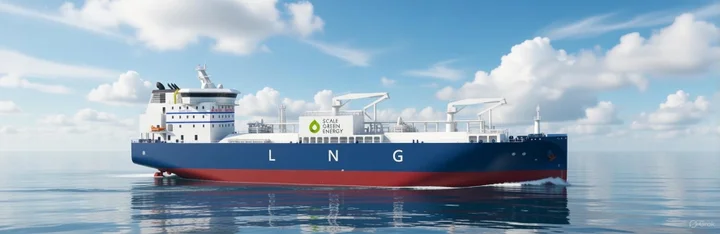
Arturo Gonzalo and Ignacio Soneira, the respective CEOs of Enagás and Axpo Iberia, visited the Port of Huelva today to present the Alisios LNG bunkering vessel set to operate in the south of the Iberian Peninsula. The vessel, which will drive the use of LNG and bio-LNG as sustainable fuels for the decarbonisation of maritime transport, is owned by Enagás through its Scale Green Energy subsidiary and it has been chartered by Axpo for commercial use.
Today’s official presentation of the vessel at the Port of Huelva was attended by authorities such as José Antonio Santano, Secretary of State for Transport and Sustainable Mobility, Benito Núñez, Secretary General for Air and Maritime Transport, María José Rico, Subdelegate of the Government in Huelva, Cristóbal Sánchez, Deputy Minister of Industry, Energy and Mines of the Government of Andalusia, Gustavo Santana, President of Puertos del Estado, Alberto Santana President of the Port Authority of Huelva, and Milagros del Rocío Romero, Mayoress of Palos de la Frontera.
José Antonio Santano, Secretary of State for Transport and Sustainable Mobility, emphasised the importance of public-private partnerships when it comes to responding to the challenges of the future and addressing those facing the port system and maritime transport as a whole. In this regard, he recalled that the investment in ports is designed to construct a more competitive, greener and better-connected port system. As part of the Investment Plan of the Port Authorities for 2029, one billion euros have been earmarked for environmental sustainability projects at ports, reaffirming the vital role of these infrastructures as spearheads of the energy transition in Spain. Moreover, last November, the Council of Ministers approved the National Action Plan for the Decarbonisation of Maritime Transport, which includes a public aid plan amounting to 250 million euros over the next five years.
Cristóbal Sánchez, Deputy Minister of Industry, Energy and Mines of the Government of Andalusia, emphasised that “industry is growing faster than ever before in Andalusia; since 2018, its Gross Value Added (GVA) has risen by 34%, driven not only by the manufacturing sector, of which Huelva is a predominant part, but also by the great lever of energy”. In this respect, he pointed out that “the energy transition is playing a key role in the growth of our industry, but it’s also laying the foundations for an even more promising future”. “Clean energy will thus become a significant factor in the location of industry that benefits Huelva. There’s talent and energy here, and they guarantee the future of our industry and the future quality of life of the people of Andalusia”, he concluded.
As for Alberto Santana, President of the Port Authority of Huelva, he thanked Enagás and Axpo for commissioning the Alisios LNG for the supply of sustainable fuels to maritime transport in the south of the Peninsula. In this regard, Santana emphasised that “this initiative will help to bolster the Port of Huelva’s commitment as a leading energy and industrial cluster to promoting the energy transition of the port environment, showcasing its capacity to attract projects linked to the decarbonisation of the sector and generating synergies with the companies that make up the port community”.
Enagás CEO Arturo Gonzalo emphasised that “the commissioning of the Alisios LNG constitutes a key milestone in the development of infrastructures that contribute to the decarbonisation of the maritime sector and the adoption of sustainable fuels such as LNG and bio-LNG, thus meeting Europe’s emission reduction targets”.
According to Axpo Iberia CEO Ignacio Soneira: “The commissioning of this new vessel is a key step towards confirming Axpo’s leadership of the LNG bunkering business in the small-scale market and facilitating the decarbonisation of maritime transport”.
Similarly, Milagros Romero, Mayoress of Palos de la Frontera, pointed to the close links between the municipality and the industrial and energy-related development of the port environment, while underlining that Palos is one of the main industrial hubs in southern Spain. In this sense, she stressed that initiatives such as the launch of the Alisios LNG, linked to the supply of more sustainable fuels for maritime transport, “will reinforce the strategic role of this area in the energy and logistics field”, while “contributing to the progress towards a more sustainable and competitive production model”.
An advanced vessel to meet the growing demand for sustainable fuels
Capable of operating with both LNG and bio-LNG, the Alisios LNG has storage capacity totalling 12,500 m³, enabling it to effectively meet supply needs.
It incorporates advanced systems that endow it with a high degree of manoeuvrability, favouring operations in different port environments. It also has technology designed to conserve fuel under the best possible conditions and optimise its fuel management throughout the voyage. The above means that the Alisios LNG is a versatile, efficient and reliable vessel which is able to guarantee more sustainable fuel supplies.
Enagás and Axpo reinforce their roles in the decarbonisation of maritime transport
Through its Scale Green Energy subsidiary, Enagás is enhancing its standing as a benchmark shipowner for LNG bunkering in Southern Europe with four vessels: The Alisios LNG, the Levante LNG, the Mistral LNG (under construction) and the Haugesund Knutsen. Both LNG and bio-LNG will thus become the alternative fuels best-positioned to lead the energy transition, as they boast the available fleet and the infrastructure provided by Spain’s seven regasification plants, which have been adapted to supply LNG and bio-LNG for bunkering: Barcelona, Cartagena, Huelva, El Musel (Musel E-Hub), Bilbao (BBG), Sagunto (Saggas) and Mugardos (Reganosa).
In its bid to remain at the forefront of the sustainable shipping transition, Axpo is continuing to expand its bioLNG portfolio and forge partnerships with the main players in the industry. Collaborative endeavours are vital if the global emission targets are to be met and progress towards a cleaner and more sustainable future for marine logistics is to be made.
LNG and bioLNG: solutions for cutting emissions in the maritime transport sector
The entry into operation of the Alisios LNG will make it possible to meet the increasing demand for alternative fuels within the sector, at a time shaped by the new European regulations requiring progressive cuts in the emissions associated with maritime transport.
LNG bunkering has undergone exponential growth in recent years in Spain, with a four-fold increase in activity between 2023 and 2025. Last year, LNG cargoes rose by 64% in the country, positioning it as a strategic hub in Southern Europe for the supply of sustainable fuels.
LNG and bioLNG are currently the alternative fuels best-positioned to lead the energy transition, as their fleet and the infrastructure required to provide bunkering services are constantly on the increase. Compared with traditional fuels, LNG eliminates 100% of sulphur oxide (SOx) emissions, 80% and 90% of nitrogen oxides (NOx) and 25% of CO2.
The use of LNG as a maritime fuel in Spain could reduce CO2 emissions by as many as two million tonnes by 2030, which would be equivalent to the replacement of over one million combustion vehicles by electric ones.
The BioLNG service has no associated emissions and uses the infrastructure interconnected with the regasification plants, in such a way that the biomethane injected into the gas grid is recognised as BioLNG, a liquid biofuel obtained by processing organic household and industrial waste.
/