The 4th Enagás Hydrogen Day demonstrated how renewable hydrogen is essential when it comes to driving Europe’s decarbonisation and strategic autonomy. During the forum, the major industries and the main players in the mobility sector reaffirmed their commitment to green hydrogen as a key vector for the promotion of competitive decarbonisation.
Sara Aagesen, Third Vice-President of the Spanish Government and Minister for Ecological Transition and the Demographic Challenge, performed the institutional opening of the event, now in its fourth year, which was also attended by Teresa Ribera, the European Commission’s Executive Vice-President for a Clean, Just and Competitive Transition, Cani Fernández, President of the CNMC (National Commission for Markets and Competition), Bernhard Kluttig, Director General for Safety, Gas and Hydrogen within the Federal Holdings of the German Federal Ministry of Economy and Energy, Cristina Lobillo, Director of Energy Policy at the European Commission’s Directorate-General for Energy, and Paloma Aba Garrote, Director of CINEA at the European Commission, among other authorities.
During the opening of the event, Sara Aagesen, Third Vice-President of the Spanish Government and Minister for Ecological Transition and the Demographic Challenge, declared that “over the coming months we’ll submit a draft bill that addresses the transposition of the European Hydrogen Package so as to create a domestic hydrogen system and a new regulated market, drive the demand for hydrogen and renewable gases, reinforce competitiveness and, of course, provide the tools required to develop the infrastructure”.

From left to right, Enagás CEO Arturo Gonzalo; Third Vice President of the Spanish Government and Minister for Ecological Transition and Demographic Challenge Sara Aagesen; Enagás Chairman Antonio Llardén; and CNMC Chairwoman Cani Fernández.
During her talk with Enagás CEO Arturo Gonzalo, Teresa Ribera, the European Commission’s Executive Vice-President for a Clean, Just and Competitive Transition, stressed that “the European Commission has made a firm commitment to hydrogen in Europe” and emphasised that “H2med is one of the most advanced European energy highway projects and that “the Commission remains fully committed to bringing these goals to fruition”.
During the session titled “The vision of the Spanish regulator”, Cani Fernández, President of the CNMC (National Commission for Markets and Competition), highlighted that “hydrogen is a joint venture. It requires the collaboration of the governments, regulation, industry and academia of all our countries and that of all of us who are gathered here today”.
Enagás CEO Arturo Gonzalo remarked that “the administrative, engineering and commercial development of the Spanish Backbone Network and H2med are progressing at cruising speed, confirming their technical feasibility and commissioning dates”, and added that “the Iberian Peninsula and Spain will play a major role in the construction of the European hydrogen economy, with the most competitive green hydrogen in Europe”.
As for the Spanish Hydrogen Backbone Network, Gonzalo explained that “a key milestone in 2025 was the Public Participation Plan, the largest process of its kind ever undertaken in Spain”. This plan, which enjoys firm backing from the institutions, industry and civil society, has already been implemented in eight autonomous communities and the process is set to continue in a further five in 2026.
Regarding BarMar, he outlined that “we’ve successfully completed the geophysical surveys and confirmed that the subsea route is technically feasible. The pre-FEED (front-end engineering design) engineering of this interconnection is currently underway”.
As for the European Hydrogen Network, Enagás Chairman Antonio Llardén pointed out that “green hydrogen provides us with a huge opportunity to build an infrastructure with a European vision from the outset, as the backbone of the EU’s energy planning”, given that “a European market isn’t possible without infrastructures”. Within this context, he stressed that “collaboration between countries, administrations and companies is essential for the development of these infrastructures”.
The talk titled “The German model, a European benchmark for hydrogen deployment” delivered by Bernhard Kluttig, Director General for Safety, Gas and Hydrogen within the Federal Holdings of the German Federal Ministry of Economy and Energy, outlined the German experience and its contribution to the development of the European hydrogen market.
Record investment and financial support
Green hydrogen already forms part of European industry’s strategic plans. Investment decisions and financial support for hydrogen projects are setting new records in Spain and Europe and around the world.
In Spain, the Government has already granted 3.155 million euros in aid to over 100 renewable hydrogen production projects totalling around 4 GW through the Recovery, Transformation and Resilience Plan.
As for the European Commission, it proposes a five-fold increase amounting to 30 billion euros in funding for cross-border energy infrastructures in the 2028-2034 Multiannual Financial Framework, awarding a prominent role to hydrogen infrastructures. In 2025, Europe led the world in terms of committed investments in green hydrogen with 12 billion dollars, according to the data provided by the Global Hydrogen Compass.
2026: the year of hydrogen’s take-off
This year, the progress of hydrogen will accelerate in all the political, investment, regulatory and technical fields. February is the deadline for the Third European Hydrogen Bank Auction, which is set to assign 1.3 billion euros. Its results will be announced in May and June.
Moreover, significant developments affecting H2med are expected at the upcoming ministerial meeting of the High-Level Group for South-West Europe, while the European Commission will publish its second definitive list of Projects of Common Interest (PCI).
This year, the Parliament and the Council are set to negotiate the Grids Package, with measures to accelerate hydrogen projects, while the Hydrogen and Decarbonised Gases Directive is due to be transposed by the member States as a key step towards a regulatory framework for hydrogen.
The flagship hydrogen event
The 4th Enagás Hydrogen Day, bringing together the main drivers of the hydrogen value chain in Europe, featured several round table discussions focused on the role of renewable hydrogen as a key vector for decarbonisation and industrial competitiveness in Europe and around the world. The experts highlighted demand, regulation and cost reductions as the major challenges facing hydrogen as its scale-up progresses.
The round table titled “The unstoppable progress of hydrogen transmission networks in Europe”, chaired by Arturo Gonzalo, featured senior executives of the main European operators, including Rodrigo Costa, CEO of REN (Portugal), Sandrine Meunier, CEO of NaTran (France), Willemien Terpstra, CEO of Gasunie (Netherlands), Pascal De Buck, CEO of Fluxys (Belgium), and Thomas Hüwener, CEO of Open Grid Europe (Germany). During the debate, they analysed the progress of the infrastructures in the different countries and highlighted the cooperation between European operators.
Committed investments around the world totalling 110 billion dollars
During the session titled “The global progress of hydrogen: from the ambition to the execution”, Hydrogen Council CEO Ivana Jemelkova provided an international vision of the evolution of hydrogen as an energy carrier and the challenges facing the acceleration of its deployment on a global scale.
“The global hydrogen industry has recorded committed investments totalling over 110 billion dollars for projects that have reached their Final Investment Decision (FID) and ones that are under construction or in operation”, declared Jemelkova. This figure encompasses 510 projects worldwide.
She also highlighted that “since 2020, investments have increased tenfold (from 10 billion to 110 billion dollars), growing at an average greater than 50% per year. This is a faster pace than that of many energy technologies in their early scale-up stages”, and added that “these aren’t just numbers”, but rather “proof that the hydrogen industry has moved on from ambition to execution”.
Subsequent sessions
After the talk with Teresa Ribera, the European Commission’s Executive Vice-President for a Clean, Just and Competitive Transition, the session titled “The French model: the hydrogen ecosystem in France” featured Hy24 CEO Pierre‑Etienne Franc and Javier Brey, President of the Spanish Hydrogen Association.
The panel discussion titled “Europe, committed to competitive decarbonisation through renewable hydrogen” featured Cristina Lobillo, Director of Energy Policy at the European Commission’s Directorate-General for Energy, Dr. Christoph von dem Bussche, President of ENNOH, and Jorgo Chatzimarkakis, the CEO of Hydrogen Europe. The debate was chaired by BarMar CEO Francisco de la Flor.
Paloma Aba Garrote, Director of CINEA at the European Commission, Roland Schulze, Managerial Advisor on low- carbon energy technologies at the European Investment Bank, Bianca Dragomir, Director of Cleantech for Iberia, and Urbano Troncoso, Executive Director of Structured Finance at Banco Santander, took part in the debate on “Funding to accelerate hydrogen investments” chaired by Sedigas President Joan Batalla.
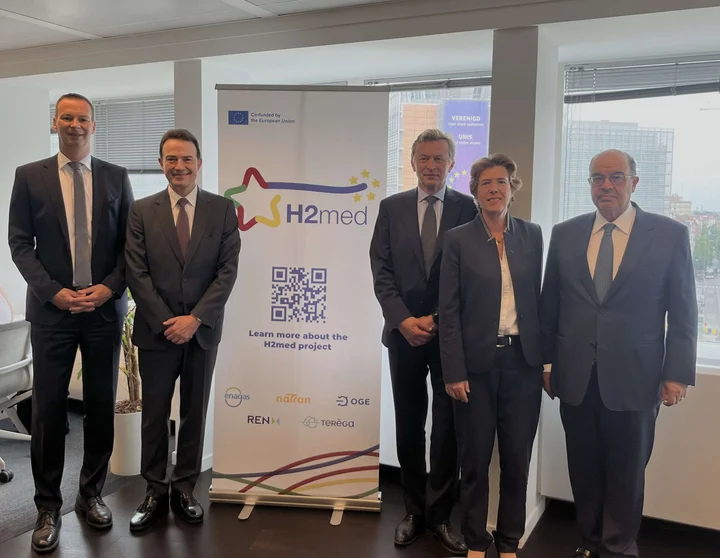
The event continued with the round table titled “The H2med Alliance, the commitment of the entire industrial value chain”, chaired by Natalia Latorre, Energy Transition General Manager at Enagás. It featured Nicolai Raß, OGE’s Director of Hydrogen and International Development, Marie Claire Aoun, Strategy Director at Teréga, Dourogás CEO Nuno Moreira, Valter Diniz, REN’s Director of Institutional Relations, and Geoffroy Anger, Head of Hydrogen and CO₂ Business Development at NaTran.
Subsequently, Audrey Ma, Executive Director of the Board and Vice-President of International Business at ReFire, led the session titled “The hydrogen economy in China”, outlining the keys to the growth of the leading country in the world in terms of total electrolysis capacity.
It was followed by the debate titled “Consolidating the demand for hydrogen: the vision of transport and mobility”, chaired by Eugenia Sillero, Secretary General of Gasnam‑Neutral Transport. The participants included Loïc Voisin, CEO of HysetCo, Audrey Ma, Executive Director of the Board and Vice-President of International Business at ReFire, Luis Felipe Suárez‑Olea, President of HVR Energy, TMB CEO Xavier Flores, Mark Freymueller, CEO of HYUNDAI Commercial Vehicles and Hydrogen Business, Miguel Carsi, Head of Business Development and Value Chain at the H2 Cluster of Toyota Motor Europe, and Emma Nogueira, Bosch’s Director of Strategy and Business Development.
The panel discussion titled “Major green hydrogen projects underway in Europe”, chaired by Cristina Rivero, Managing Director of the Spanish Energy Club, included Juan Lladó, President of Técnicas Reunidas, Thyssenkrupp CEO Miguel Ángel López Borrego, Soeren Toftgaard, a partner at Copenhagen Infrastructure Partners, Sunfire CEO Nils Addag and Alan Ripa, the CEO of Acciona Plug.
Enagás CEO Arturo Gonzalo chaired the closing session and the conclusions.
/